
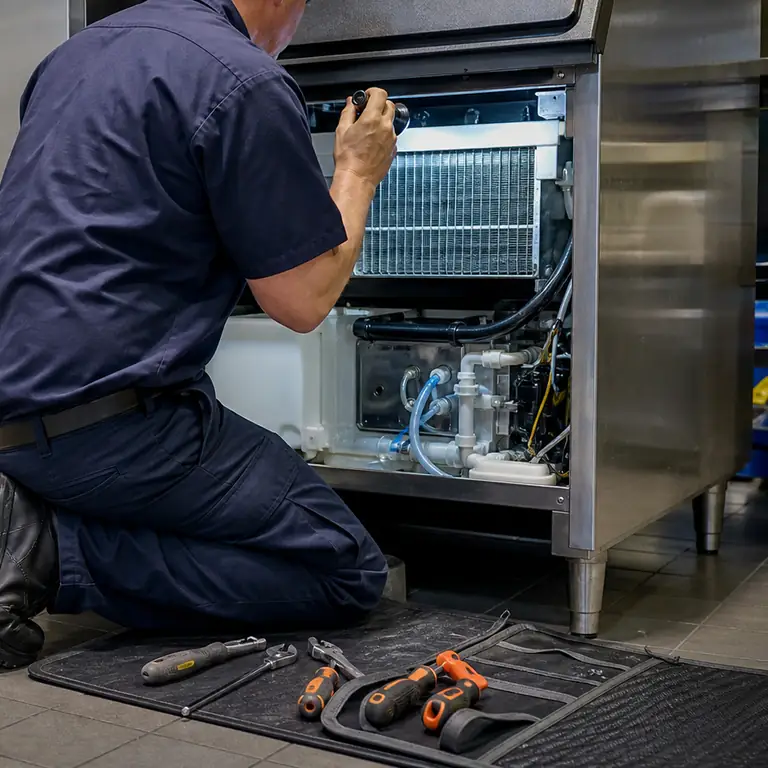
Fort Worth Cold Care helps commercial operators request ice-machine repair for slow production, no ice, freeze-up, incomplete harvest, water faults, scale, and refrigeration problems. Output must be compared with demand and operating conditions, not merely whether one batch eventually drops.
Last updated: August 26, 2026
What happens on the first visit
The technician should identify the machine and bin, observe the freeze and harvest sequence, inspect water supply and filtration, evaluate cleanliness and scale, measure relevant temperatures, check condenser conditions, and test controls and refrigeration performance as required.
Slow ice production has water and refrigeration causes
Restricted filters, low water flow, scale, hot incoming water, dirty condensers, hot intake air, controls, and refrigeration capacity can all lengthen a cycle. A complete cycle observation is more useful than replacing the first component near an alarm.
Cleaning and repair are related but not interchangeable
Mineral scale and biofilm can impair water distribution and sanitation, while a refrigeration or control failure requires separate diagnosis. A repair visit should say clearly whether cleaning, sanitizing, descaling, or component work is included.
Peak demand should be part of the sizing decision
An operating machine may still be too small for a bar, hotel, healthcare, or event-driven demand profile. Compare rated production under stated conditions with real draw, bin capacity, ambient heat, and recovery time.
Understanding service charges and estimates
Ask for the call or diagnostic fee, included time, labor structure, service radius, and after-hours policy before dispatch. Published DFW examples retrieved August 26, 2026 include a $59 commercial ice-machine service call with $110 hourly labor, a $194.68 refrigeration call including one diagnostic hour, and a $254.25 emergency after-hours call. Those are other providers’ published entry charges—not quotes for this site or your equipment.
What the service scope can include
- Machine and bin identification
- Freeze/harvest cycle observation
- Water supply and filter checks
- Scale and cleanliness assessment
- Condenser and intake-air review
- Control and sensor testing
- Refrigeration performance checks when indicated
- Written cleaning and repair scope