
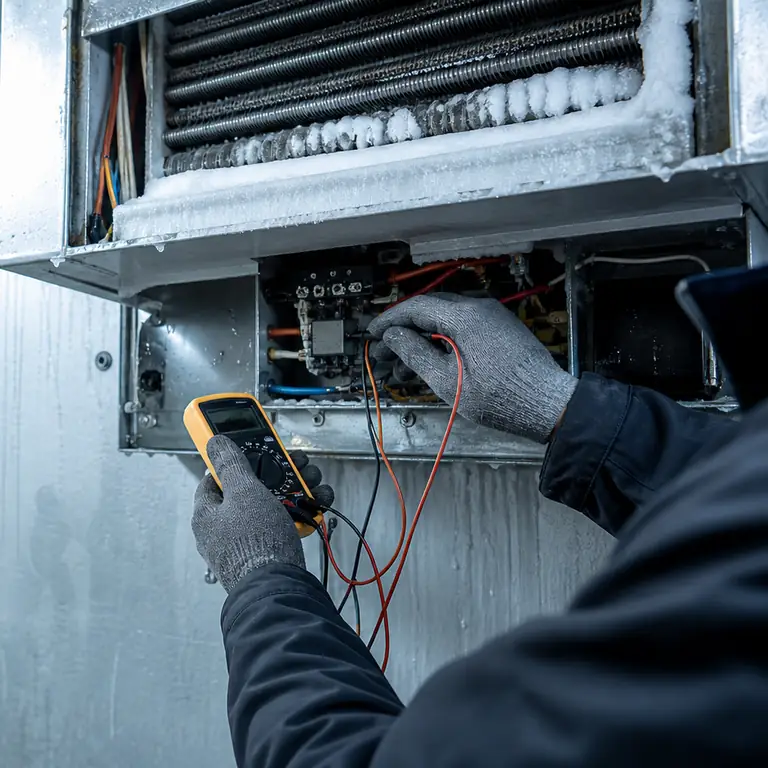
Fort Worth Cold Care organizes walk-in freezer repair requests around the temperature trend, frost pattern, defrost history, door condition, and equipment configuration. Frozen-product risk and safe access come first; a forced reset is not a diagnosis.
Last updated: August 26, 2026
What happens on the first visit
The first visit should document box temperature, product condition, alarms, frost distribution, evaporator fans, door infiltration, drain heat, defrost schedule, heaters and termination controls where fitted, condenser condition, and the refrigeration circuit when evidence points there.
Frost pattern separates several very different failures
Uniform heavy ice, frost concentrated near an entry point, a partially fed coil, and frozen drain water do not tell the same story. The pattern should be photographed before thawing because it can narrow defrost, airflow, infiltration, and circuit causes.
Defrost parts must work as a sequence
Timers or controllers, heaters or hot-gas components, fan delays, termination devices, drains, and safeties act together. Replacing one visible part without testing the sequence can leave the original failure intact.
A freezer door is part of the refrigeration system
A torn gasket, weak closer, bent threshold, damaged sweep, or repeated propping introduces moisture and sensible load. Correcting infiltration can be as important as work at the evaporator or condensing unit.
Understanding service charges and estimates
Ask for the call or diagnostic fee, included time, labor structure, service radius, and after-hours policy before dispatch. Published DFW examples retrieved August 26, 2026 include a $59 commercial ice-machine service call with $110 hourly labor, a $194.68 refrigeration call including one diagnostic hour, and a $254.25 emergency after-hours call. Those are other providers’ published entry charges—not quotes for this site or your equipment.
What the service scope can include
- Temperature and alarm history
- Frost-pattern documentation
- Door, gasket, closer, and threshold inspection
- Evaporator fan and airflow checks
- Defrost control, termination, and heater testing
- Drain and drain-heat assessment
- Condenser and electrical inspection
- Written findings and verification